



Blog
Distracted Driving Accidents Involving Pets
Filed under Car Accidents Published on April 27, 2020 and updated on July 20, 2026.
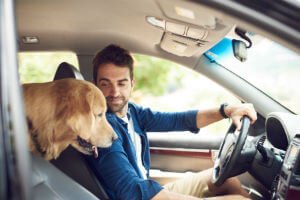 Many people often bring a pet along on a trip or to run an errand. While pets can provide great companionship, having your four-legged friend loose inside the vehicle while driving can create a serious distraction and result in an accident.
Yes. Driving with an unrestrained pet can distract you by taking your attention, hands, or eyes off the road, increasing the risk of an accident. While Maryland does not specifically require pets to be restrained, a loose animal that interferes with your ability to drive safely could still lead to liability or a traffic citation.
Our Baltimore car accident attorneys discuss why driving with unrestrained pets can be so distracting and offer advice on how to safely travel with a pet. Request a free consultation to learn about your rights.
Pet Distractions While Driving
To keep you and others safe, it is important to avoid driving while distracted. An unrestrained pet inside a vehicle can cause the driver to divert his or her attention, hands or eyes off the road. This kind of distraction is just as dangerous as texting or talking on a cellphone.
Pets can cause drivers to become distracted in a number of ways, such as:
- The pet moves about the vehicle or climbs on the driver’s lap
- The pet barks or makes some noise that causes the driver to turn around
- The driver needs to pet a nervous animal to calm it down
- The driver needs to hold the pet so the animal does not fall
- The pet is able to get near the pedals or under the driver’s feet
- The driver or another passenger takes photos with or of the pet
- The driver feeds the pet or gives it some water
- The driver or another passenger plays with the animal
How to Drive Safely With Pets
Driving with your pet in a vehicle does not need to be dangerous. There are several things you can do to prevent your pet from becoming a distraction and causing an accident. This includes the following:
- Properly restrain your pet – The ideal restraint will depend on the type and size of your pet. Crates can be used for cats and small dogs, though there are bigger crates for larger pets too. Just make sure that it is large enough for your pet to stand up and turn around. Harness seat belts can keep your pet strapped in place from wandering around the vehicle while driving and pet barriers mounted to the ceiling can keep your pet in place in the back sections of a vehicle.
- Pets should not ride on your lap – As much as your pet may love to sit on your lap, it is one of the least safest places for a pet to ride. Even if your pet is well-behaved, it is a distraction for you and could cause you both to suffer serious injuries in a crash, especially if the airbags deploy.
- Pets should not travel near open car windows – While dogs especially enjoy sticking their heads out of windows, it could cause your pet to get struck by dirt, rocks, or other flying debris.
- Adjust your pet’s feeding times – Try not to feed your pet meals or treats while driving or limit their food or water a few hours before a long car trip to avoid your pet getting sick or going to the bathroom in the vehicle. Be sure to also make regular stops so your pet can take a break.
- Pets should not ride in the bed of a truck – Pets should not be transported in the bed of a pickup truck even if they are leashed or placed in a crate. There is no protection against strong winds and flying debris. If a pet falls out, they could be injured, killed or cause an accident.
Maryland Laws on Unrestrained Pets
The state of Maryland currently does not have any laws which prohibits driving with an unrestrained pet in your vehicle. Drivers are not legally required to restrain or secure an animal during transportation.
However, Maryland Transportation Code Section 21-1104 does state that no one can drive a vehicle on the highway with any type of object, material or obstruction that would interfere with the clear view of the driver through the windshield. This may be applied to pets riding in a driver’s lap.
A police officer could even choose to ticket a driver if he or she thinks that a pet is making it difficult for a driver to see, steer or simply focus on the road.
Frequently Asked Questions About Pets and Distracted Driving Accidents in Baltimore
Can a driver be liable if their pet caused a car accident?
Yes, a driver may be liable if an unsecured or distracting pet caused them to lose focus and crash. Drivers have a duty to operate their vehicles safely and control distractions inside the car. The Law Offices of Peter T. Nicholl can review whether pet-related distraction contributed to the collision and resulting injuries.
How can pets contribute to distracted driving accidents?
Pets can contribute to distracted driving accidents by climbing onto the driver’s lap, blocking visibility, interfering with steering, or causing the driver to look away from the road. Legally, these actions may support a negligence claim if the distraction caused the crash. Evidence should show how the pet affected the driver’s control or attention.
Is driving with an unsecured pet considered negligence?
Driving with an unsecured pet may be considered negligence if the pet creates a foreseeable distraction or safety risk. A claim may focus on whether a reasonable driver would have restrained the animal to prevent interference with driving. The facts of the crash, witness statements, and driver behavior are important when evaluating fault.
What evidence can prove a pet distracted the driver before a crash?
Evidence may include witness statements, police reports, dashcam footage, interior vehicle photos, admissions by the driver, or observations that the pet was loose in the car. Liability depends on connecting the distraction to the driver’s unsafe action and the crash. The Law Offices of Peter T. Nicholl can help identify evidence that supports causation.
Can I recover compensation if I was injured by a driver distracted by a pet?
Yes, you may be able to recover compensation if the driver’s pet-related distraction caused the accident and your injuries. Damages may include medical bills, lost wages, pain and suffering, and long-term limitations. A successful claim must show negligence, causation, and the full impact of the injuries.
What if the driver denies that their pet distracted them?
If the driver denies being distracted by their pet, other evidence may still prove what happened. Witness accounts, crash scene details, vehicle positioning, statements made after the crash, and police observations can help establish liability. In disputed cases, The Law Offices of Peter T. Nicholl can evaluate whether the evidence supports a negligence claim.
Can a pet-related crash cause serious injuries?
Yes, a pet-related distracted driving crash can cause serious injuries, especially when the driver swerves, rear-ends another vehicle, or fails to brake in time. Injuries may include neck injuries, back injuries, fractures, head trauma, or long-term pain. Medical documentation is important to connect those injuries to the crash.
When should I contact a lawyer after a pet-related distracted driving accident?
You should contact a lawyer after a pet-related distracted driving accident if you were injured, fault is disputed, or the insurance company questions the cause of the crash. These cases may require evidence showing the pet created a distraction and that the distraction caused the collision. The Law Offices of Peter T. Nicholl can assess the claim before settlement discussions begin.
Speak With a Dedicated Attorney Today
If you have been injured in a collision caused by distracted driving, do not hesitate to contact our dedicated attorneys at The Law Offices of Peter T. Nicholl for help. Our team are ready to represent you and guide you throughout the legal process should you have a valid claim.
Let us discuss your available legal options in a free, no-obligation consultation. Our firm operates on a contingency fee basis, which means no upfront fees for our services. You only pay us if we help you win.
Contact our office today by calling 410-244-7005.
Related Topics
- Ways to Prove Distracted Driving Caused a Crash
- Proving Fault for a Drowsy Driving Accident
- Evidence That Can Strengthen a Car Accident Claim

